

 iscover

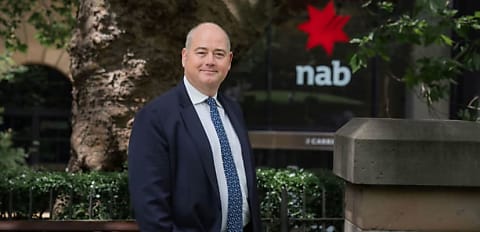

National Australia Bank (NAB) chief executive Andrew Irvine has warned that stress is increasing across its business lending book, with smaller companies facing the toughest conditions despite strong credit growth.
Speaking at the House of Representatives standing committee on economics in Canberra on Friday (13 November), Irvine said borrower pressures were building.
“I don’t yet see the insolvencies rising, but I do see stress in our business lending book, and the level of stress is increasing,” he said.
He added that the difficulties were unevenly distributed, with business size emerging as a clear dividing line.
“So small businesses are doing it tougher than medium businesses. Medium businesses doing it tougher than larger businesses,” Irvine said.
The warning comes as Australia’s largest business lender continues expanding, with NAB’s Australian business lending balances increasing 9.8 per cent in FY2025–26.
Strong credit growth meets a softer economy
Irvine described an unusual environment in which substantial demand for business credit was coinciding with weakening economic conditions, rather than signalling strength across the economy.

“The challenge that we have at this point in the economic cycle is that we have what I would call an uneven economy, and this is quite rare,” he said.
“I haven’t seen this in my banking career, where on the one hand we have incredibly strong business credit growth, and last year it grew double digit for NAB and actually for the entire system, and at the same time we have a softening economy, and usually you don’t have strong credit growth in a softening economy.”
That divergence is evident across the major banks, with KPMG’s FY25–26 analysis recording aggregate business lending growth of 12.2 per cent, nearly three times the 4.3 per cent increase in consumer lending.
However, expanding portfolios are accompanied by greater credit costs. KPMG found impairment charges increased 56 per cent, although overall delinquency levels and provisions remained low relative to the banks’ lending books.
Irvine said that the combination of lending growth and deteriorating customer risk assessments was consuming capital, while the softer outlook had prompted NAB to increase its forward-looking provisions.
“The problem is that both of those things are highly capital-consumptive. So, in a softened economy, you have risk rating degradation, which comes when your customer’s financial situation is worsening,” he said.
“Then when the risk rating for a customer reduces, as a bank, in order to ensure we are a safe and strong bank, we have to add more capital against that loan in case that loan happens to go south or go delinquent.
“So, we’ve had to significantly raise our forward-looking provisions due to our assessment that the economic environment is softening, and we increased our forward-looking provisions very significantly this year.”
Westpac pursues greater business lending growth through existing customers
Despite those emerging pressures, Westpac chief executive Anthony Miller told the committee that business credit remained positioned to grow faster than mortgages over the coming year.
“We’re forecasting business credit will likely grow in the order of 7 per cent in the next 12 months and looking at the kind of pipeline and the activity and we’re forecasting credit growth in the mortgage book of approximately 3.8 per cent terms of the next 12 months,” Miller said.
“So we would expect more growth in the business side of the balance sheet versus the mortgage side of the balance sheet.”
Miller said Westpac wanted to expand its business bank but emphasised that most recent growth had come from existing customers.
“We want to grow the business bank at Westpac, we very much do want to grow in that area. I would say that we enjoyed very significant growth in the business bank over the last 12 months,” he said.
“But 76 per cent of that growth was with existing customers.”
He said supporting those established relationships would remain central to the bank’s expansion.
“So, we definitely want to grow, but the cornerstone of that growth is existing customers, helping them deliver on what they want to deliver on,” he said.
Westpac’s FY25–26 results reported business lending growth of 12 per cent and institutional lending growth of 18 per cent.
Meanwhile, the Commonwealth Bank of Australia’s latest quarterly update showed that business lending, excluding its institutional banking division, increased 13.6 per cent over the year to September.
It attributed growth to proprietary customer relationships and continued business investment demand.
Mortgage returns sharpen the commercial focus
The expansion reflects a broader contest for business customers as mortgage competition and distribution costs constrain home lending returns.
At the parliamentary hearings, Australia and New Zealand Banking Group (ANZ) chief executive Nuno Matos challenged the profitability associated with housing lending and described mortgages as “one of the least profitable businesses in banking in Australia”.
Matos also pointed to business banking’s stronger net interest margins, fee opportunities and transaction deposit relationships.
ANZ’s business and private bank division increased lending 6 per cent to $156 billion in FY25–26, compared with 4 per cent growth in Australian retail home lending.
Alongside his credit warning, Irvine argued that Australia needed more funding options for younger businesses whose risk profiles were better suited to equity than bank debt.
“I think one of the areas that I think Australia could do more is to really build out a venture and a private equity ecosystem. Obviously, some of the more smaller, newer, founder-led type businesses are more amenable to equity risk versus bank capital risk,” Irvine said.
“And you look at economies like Israel or America; those are very dynamic economies where I think it’s undeniable that they would have more access to venture capital in that kind of early stage of a business’ life stage.”
Irvine also defended NAB’s workforce restructuring as a way to redirect capital towards “customer-facing banking teams”, which he said would allow more bankers to work directly with small businesses on their growth plans.
[Related: Business outlook darkens as forward orders slump]
 Want to see more stories from trusted news sources?
Make Broker Daily a preferred news source on Google.